AI in Ride-Hailing: Transforming the Future of Transportation

Contents
This project adopts an intelligent Agent platform architecture designed for the transportation domain, achieving a one-step travel service experience through AI that enables multi-end access, natural language interaction, and automatic task execution.
Overall Architecture
- Centered on “user travel needs”, the system reaches users through multiple access channels, utilizing “independent intelligent agents” and “sub-intelligent agents” to provide differentiated service capabilities. At its foundation, it relies on the Qwen general large model and Whale deployment business fine-tuned models, combined with core technologies such as RAG, context engineering, and workflows, to build powerful intent understanding and task execution capabilities. Meanwhile, the system integrates shared basic service tools including transportation capacity, transactions, strategies, LBS, risk control, and marketing, supporting cross-system calls and implementing unified model management and elastic scheduling through a model gateway.
- Ultimately forming a highly available, scalable, and reusable intelligent travel service platform. The architecture diagram is as follows:
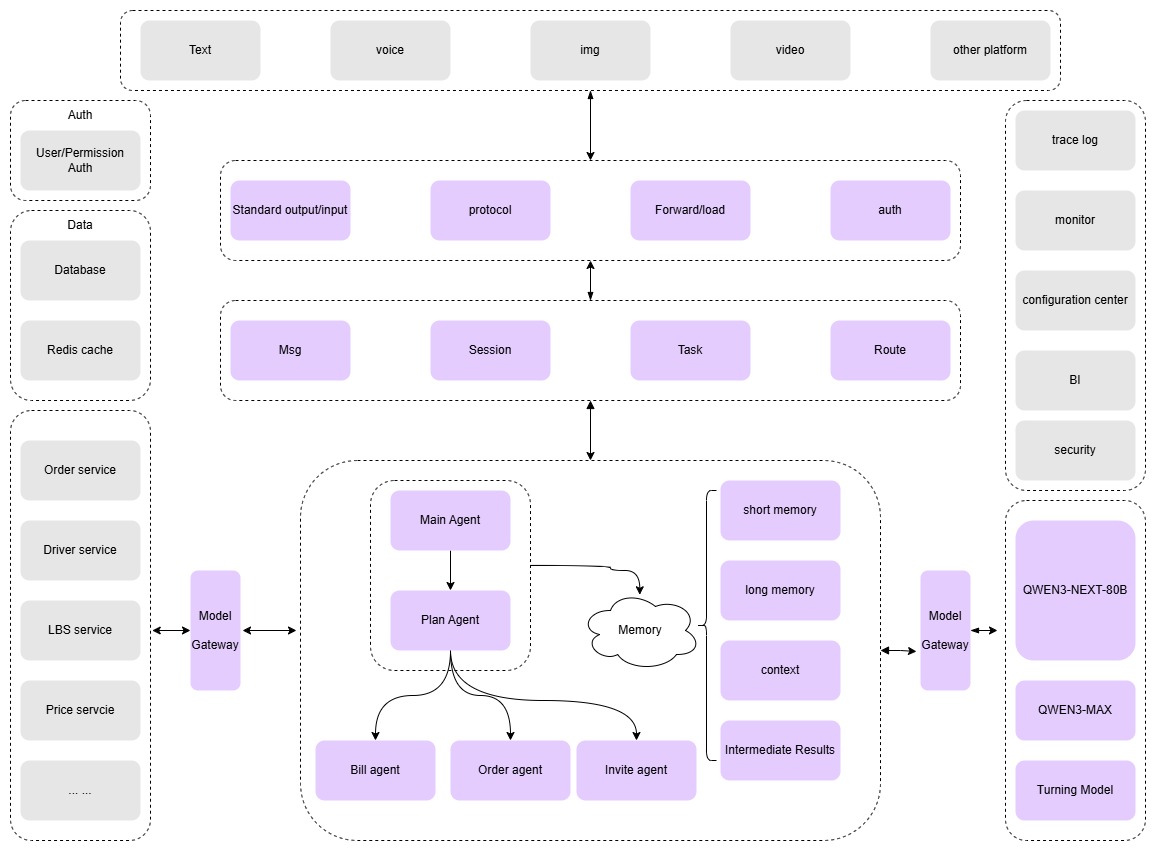
- Access Channel Layer: Supports multi-end access including app, WeChat, mini-programs, and voice assistants, providing users with convenient entry points.
- Business Scenario Layer: Focuses on various travel scenarios such as ride-hailing, car rental, and public transportation, delivering targeted services.
- Application Capability Layer: Integrating intent recognition, slot extraction, context engineering, knowledge base RAG, workflow SOP, and Agent orchestration to provide robust application capabilities.
- Foundation Model Layer: Provides underlying large model support, including general large models and business fine-tuned models.
- Shared Basic Services and Data Infrastructure Layer: Offering essential services such as transportation capacity, transactions, strategies, LBS, risk control, and marketing, along with data storage and processing capabilities.
Core Processes
Access Interaction
- Components: Input Access Layer + Output Layer
- Core Responsibilities:
- Uniformly process multi-end user inputs and standardize the generation of final responses, achieving a bidirectional interaction loop between the system and users.
Semantic Understanding
- Instant context: business information, user input. The core content includes: user information, session ID, full-link ID, original Query.
- Short-term memory: user’s current session information. The core purpose of short-term memory is to record the key information of the current session, including: user intent, slot information, context information, etc.
- Long-term memory: user’s historical interaction information. The core purpose of long-term memory is to store the user’s historical interaction information, including: historical orders, preferences, feedback, etc.
- RAG: Build a category-standard question-similar question system, recall relevant intents based on user input, and provide support for intent recognition and slot extraction.
Slot Extraction and Clarification
- Extract structured business parameters to support task execution.
- Focus on accurately extracting structured business parameters from user input, ensuring the integrity and correctness of information for subsequent task execution.
Task Execution
- Task Distribution: Route to corresponding processing path based on recognized user intent and extracted slots.
- Sub-Agent Collaboration: For complex tasks, coordinate multiple sub-agents to complete the task.
Business Evaluation
Evaluation Dataset Design
{
  "sample_id": "unique_sample_identifier",
  "input": "User's natural language query or command",
  "context": ["String", ...],//multi-round conversation context
  "expected_output": "The ideal response or action expected from the system",
  "expected_actions": [
    {
      "api": "create_order",
      "parameters": {
        "pickup_location": "Location A",
        "dropoff_location": "Location B",
        "ride_type": "Standard"
      }
    }
  ],
  "metadata": {
    "domain": "ride-hailing",
    "subtask": "order_creation | order_cancellation | fare_estimation | driver_tracking",
    "difficulty_level": "easy | medium | hard",
    "user_attributes": {
      "user_id": "unique_user_identifier",
      "user_preferences": {
        "preferred_ride_type": "Luxury",
        "frequent_routes": ["Location A to Location B", ...]
      }
    }
  }
}
Storage and Access
- Storage Location: Excel + OSS online logs + database
- Version Control: Configuration center
- Access Interface: RESTful API
Execution Process
- Task Scheduler: supports manual triggering, scheduled tasks, and A/B testing.
- Result Aggregator: collects and organizes execution results.
- Root Cause Analyzer: analyzes failure reasons and provides improvement suggestions.
Evaluation Results
- Intent Recognition Accuracy: 90% (where order placement accuracy is 99%, recall rate is 86%, and F1-score is 92%)
- Slot Recognition Accuracy: 93%